Financial capability grows when people can connect learning with their own interests, priorities and everyday lives.
Financial literacy is not learned by talking about money. It is learned through experiences that help people understand value, choice, responsibility and independence.
Illustrative image; not the participant in this learning example.
Learning example 01
The Future Phone
An 11-year-old participant with autism had a strong interest in technology and mobile phones.
Working with parents, educators and allied health supports such as occupational therapy and psychology services, learning activities were designed around an existing interest.
Visits to technology retailers such as Apple, Samsung and JB Hi-Fi became opportunities to compare products, understand value and explore pricing.
Over time, conversations expanded beyond technology. Topics included income, work, saving, goals and value.
The participant eventually asked: “How many days would Mum need to work to buy this phone?”
What started as an interest in technology became a practical lesson in financial literacy and goal setting.
Understanding Value
Goal Setting
Financial Literacy
Community Participation
Illustrative image; not the participant in this learning example.
Learning example 02
Learning to Make Money Last
A 19-year-old participant receiving Centrelink support was developing greater financial independence.
Practical learning focused on grocery shopping, meal planning, budgeting, cost of living and wants versus needs.
Activities included making shopping lists, comparing products, adding up a basket total and planning a budget between income payments.
The participant practised making informed decisions in real-world environments.
Budgeting
Independent Living
Planning Ahead
Everyday Financial Decision Making
Illustrative image; not a participant in this learning example.
Learning example 03
Making a Home Your Own
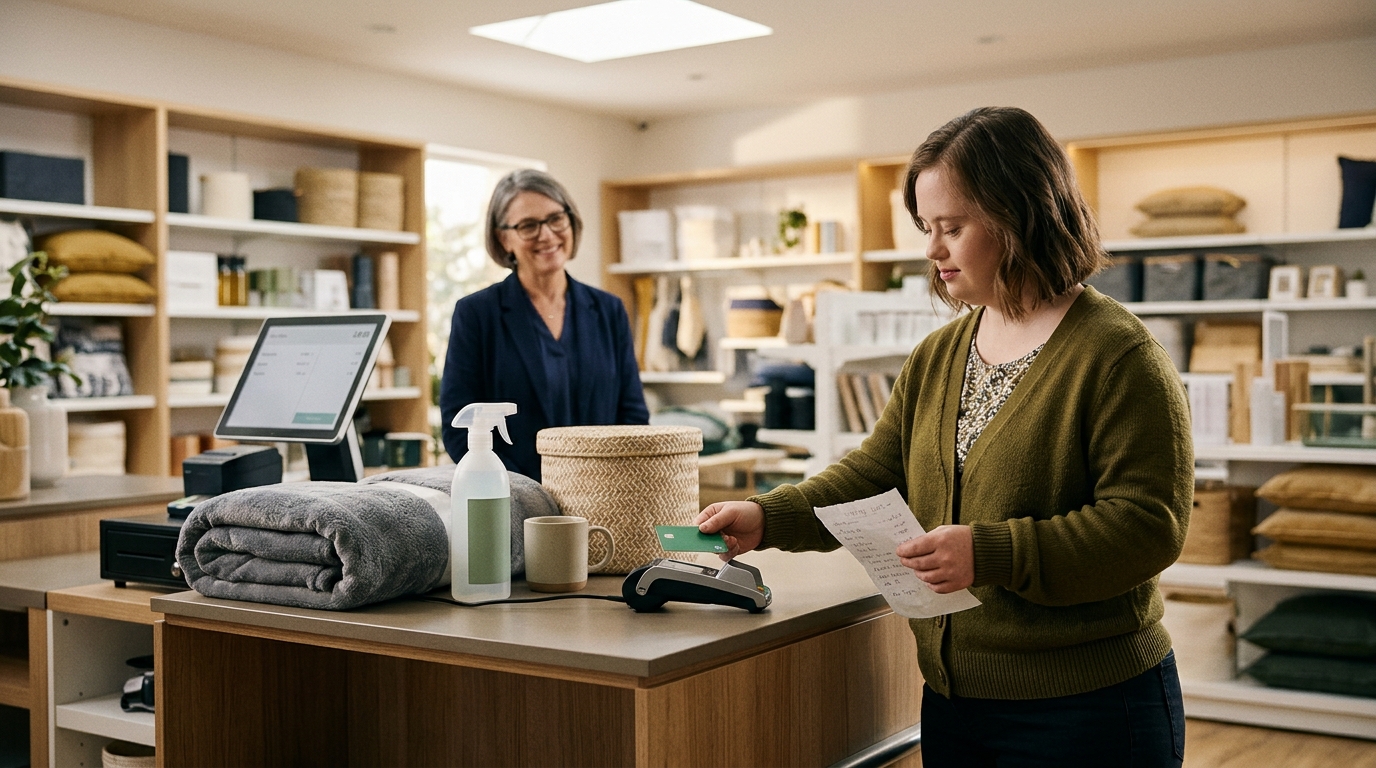
After moving into her own rental home, a young adult was excited to furnish it. Like many rental and public housing homes in Australia, it was completely unfurnished.
Homewares and furnishings were tempting purchases, so the learning focused on making choices without spending the whole budget at once. Together, the participant made a room-by-room list, sorted essentials from items that could wait, compared prices and planned purchases over time.
For each shopping exercise, the participant practised setting a spending limit, checking the list before buying and deciding whether an item was a priority or a later goal. The participant remained in control of every choice and used their own agreed spending allowance.
Key takeaway
A home can be made personal one planned purchase at a time. Prioritising what is needed now, comparing value and saving for later can help a person settle into their home while keeping money available for other costs.
Independent living
Prioritising essentials and wants
Comparing prices and value
Budgeting and saving for a home
These learning examples are shared without names or identifying details. Images are illustrative and do not show the people described. Every participant’s goals and outcomes are individual; examples do not guarantee a particular result.
Start with what matters to you.
Tell us about the everyday skills you want to build and we can discuss possible learning pathways and next steps.